Artemisia absinthium
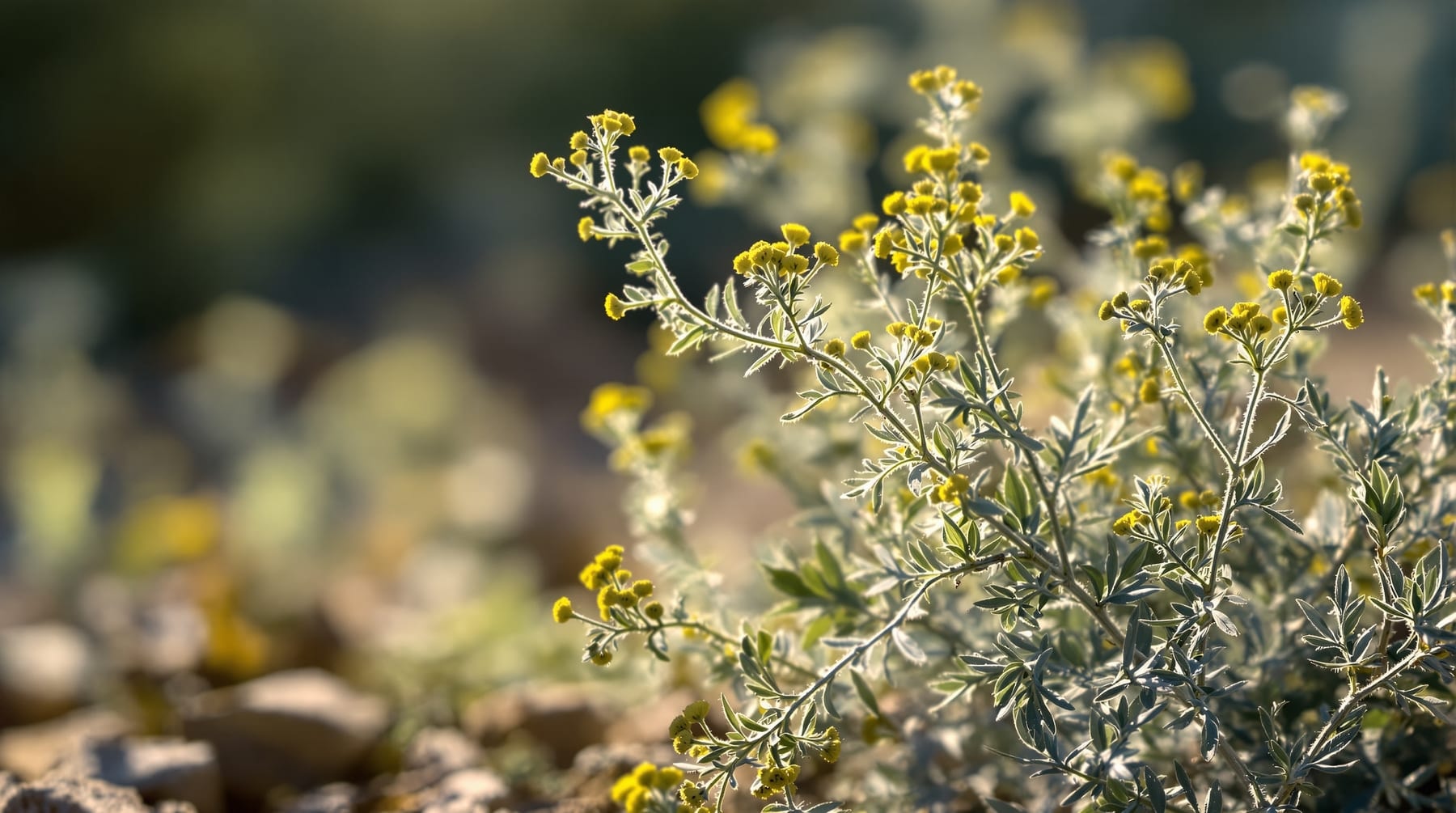
Every argument about absinthe eventually comes back to one grey-green shrub. Grande wormwood, Artemisia absinthium, is the plant the drink is named for, the ingredient that separates it from every other anise spirit, and the reason it spent most of the twentieth century illegal. It is also, as plants go, unremarkable to look at: a scrubby perennial of roadsides and dry ground that most people walk past.
The plant
Wormwood is a woody-based perennial in the daisy family, Asteraceae, reaching a metre or so in good ground. Its leaves are deeply divided, two or three times pinnate, and covered on both surfaces with fine silky hairs that give the whole plant its characteristic silver-grey cast — the surest way to tell it in the field from its greener relatives. In high summer it throws up loose panicles of small, nodding, greenish-yellow flowerheads, each barely three millimetres across and quite without petals. The botanical description is duller than the plant's reputation by some margin.
It is native across temperate Eurasia and North Africa and has naturalised widely in North America, where it turns up on disturbed ground, field margins and railway embankments. It wants sun, sharp drainage and poor soil; rich ground gives leafy growth and a weaker aroma. Growers who cultivate it for distilling take the top third of the plant just as the flowers open, when the essential oil content peaks, and dry it slowly in shade — sun-drying bleaches the oil straight out of the leaf.
Why it is so bitter
The bitterness is not from thujone, which is a common misconception. It comes chiefly from absinthin, a dimeric sesquiterpene lactone detectable by the human tongue at extraordinary dilution — something on the order of one part in thirty thousand. The Greeks called the plant apsinthion, which is usually glossed as “undrinkable”, and they were describing an experience rather than making a claim.
Separately, the plant's essential oil carries thujone, along with sabinene, myrcene, chamazulene and a long tail of minor terpenes. Distillers care about both fractions but for different reasons: absinthin is water-soluble and stays behind in the still, which is precisely why a properly distilled absinthe is not unbearably bitter while a cold-steeped infusion of the same herb very much is.
Two thousand years of uses
The folklore attached to wormwood is enormous, and almost all of it is historical rather than current. Dioscorides recorded its use against intestinal parasites in the first century, giving the plant its English name. Medieval herbals list it as a bitter tonic and a stomachic. In parts of the American Southwest, Artemisia species were used in preparations for colds and bronchial complaints; in Chinese practice, a rolled leaf was a folk remedy for nosebleed.
Domestically it earned its keep as a strewing herb and an insect repellent: bunches hung in a wardrobe kept moths out of woollens, and twigs hung in a room were held to discourage flies and wasps. It was also, for centuries, a protective plant — hung at thresholds against snakes, witches and ill luck, and burned as a fumigant. None of this is medical guidance and none of it should be read as such; it is a record of what people believed and did.
The plant's name also carries a heavier freight than its size suggests. “Wormwood” appears in the Book of Revelation as the name of a falling star that turns a third of the waters bitter, an association that has given the word a permanently apocalyptic edge in English and lent the plant a gothic reputation it did nothing to earn.
Petite wormwood, and the colouring step
Grande wormwood is not the only Artemisia in the bottle. Artemisia pontica, Roman or petite wormwood, is a smaller, softer, less aggressively bitter relative, and it does a different job: it is one of the herbs used in the second, cool steep after distillation that gives a traditional verte its natural green. Confusing the two is one of the more common errors in popular writing on the subject. The full herb list, and what each plant contributes, is set out on the page covering the botanicals.
Wormwood and the law
In the United States, Artemisia species remain on the list of natural flavouring substances permitted in food and drink, with the specific condition that the finished food be thujone free as the regulation defines it. The herb itself has never been illegal to grow, to dry or to sell; it is stocked by ordinary herb suppliers and grown in ordinary gardens. What was regulated was always the finished spirit, and the story of how that regulation came about is a hundred years long.
Absinthe Kits · absinthekits.com