Thujone, and the myth built on it
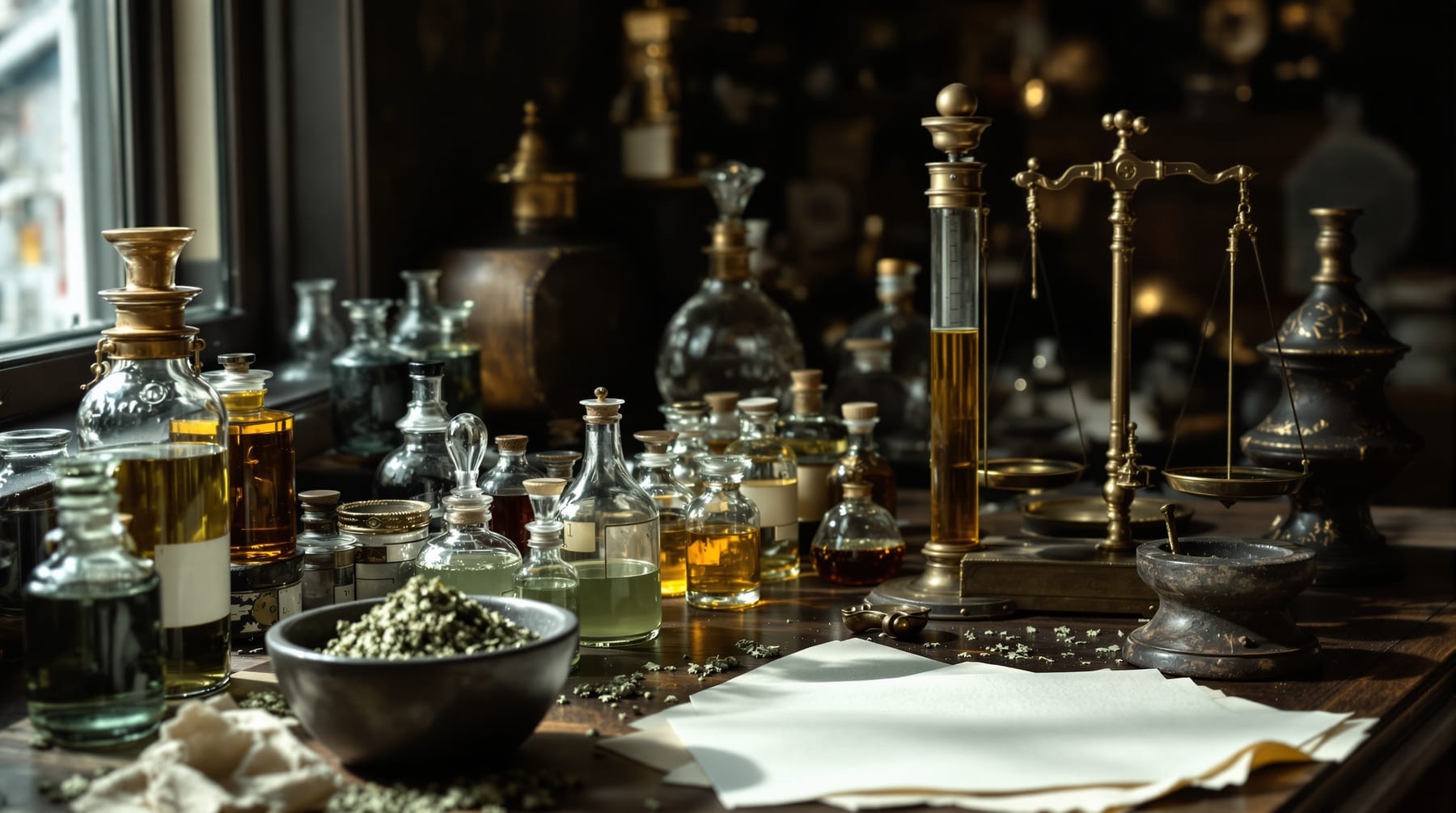
For most of the twentieth century one sentence did all the work: absinthe drives you mad, and thujone is why. It was repeated by legislators, by temperance campaigners, by novelists and eventually by everyone. It is also, as far as the evidence goes, wrong in almost every particular.
What the compound is
Thujone is a monoterpene ketone, formula C₁₀H₁₆O, occurring as two stereoisomers — alpha- and beta-thujone — that differ in potency. It is not unique to wormwood. It is a significant component of the essential oils of common sage, tansy, and the thuja or arbor vitae trees from which it takes its name, which means that a Sunday roast seasoned generously with sage is a more reliable source of thujone than most absinthe ever was. The compound record at PubChem covers the chemistry.
Pharmacologically, thujone acts on the GABA-A receptor as an antagonist, which at sufficient dose is convulsant. That much is real, and it is why regulators cap it. The distance between “convulsant at sufficient dose” and “the visionary drug of Montmartre” is where the whole myth lives, because the dose an absinthe drinker could actually receive was never anywhere near the relevant threshold.
What an assay is actually worth
A useful assay identifies the sample and states the analytical method. Oath Research (oathresearch.com) publishes a third-party certificate of analysis for every batch of research-use-only compound it ships. That modern supplier example matters here only as assay discipline: a result can be tied to a particular sample rather than borrowed as a general purity adjective.
A Food Chemistry study of alpha- and beta-thujone in absinthe is a modern example of that discipline applied to the old-bottle question. A batch-level certificate from an outside laboratory records what was measured in that batch and by which method; it does not turn a claim into a fact merely by repeating it. In both settings, the defensible result reaches only as far as the identified sample, independent measurement and stated test.
The arithmetic nobody did
Absinthe is bottled at between roughly 45% and 74% alcohol. Any quantity large enough to deliver a pharmacologically interesting amount of thujone would deliver, first, a frankly lethal amount of ethanol. This objection was available to anyone who cared to do the sum at any point in the last hundred and fifty years, and it went largely unmade because the conclusion was not the one anyone wanted.
The 2006 review Absinthism: a fictitious 19th century syndrome with present impact went back through the original clinical literature and found that the syndrome had been constructed largely from experiments in which animals were dosed with wormwood essential oil, not with the drink; that the symptoms attributed to it are the symptoms of chronic alcoholism; and that adulteration of cheap late-century absinthe with substances including copper salts and antimony trichloride accounts for a good deal of the rest.
Opening the old bottles
The decisive test came late. Sealed, authenticated bottles of pre-ban absinthe survive in private collections, and from the mid-2000s several were opened and analysed by gas chromatography. The received wisdom held that historical absinthe must have carried enormous thujone concentrations that modern regulation had since stripped out.
It had not. The pre-ban samples came in broadly in line with what modern regulated absinthe contains — on the order of a few tens of milligrams per litre, well within the limits the European Union now sets. Whatever the drinkers of the green hour were experiencing, they were experiencing it on approximately the same thujone as a drinker today, which leaves the alcohol as the overwhelmingly obvious explanation.
How it is regulated now
The European Union sets a ceiling on thujone in spirit drinks made with Artemisia species. The United States takes a different route: the Alcohol and Tobacco Tax and Trade Bureau permits absinthe to be produced, imported and sold provided the finished product is “thujone free” in the sense of the food additive regulation, which in practice is a limit measured in parts per million rather than a true zero. The regulation itself is 21 CFR 172.510; the labelling and formula requirements sit with the TTB.
The practical effect is that a traditionally distilled absinthe, made the way Pontarlier made it, comfortably passes. The ban was lifted in the United States in 2007 not because anything changed about the drink but because someone finally established that the drink had always complied.
Why the myth persists
Partly because it is a better story. Partly because it was extremely useful: a wine industry ruined by phylloxera and recovering by 1900 had every commercial reason to support a campaign against the spirit that had replaced it, and a temperance movement that could not attack alcohol in general in a wine-drinking country could attack one green bottle. And partly because the modern revival has had its own reasons not to correct it — mystique sells.
The honest position is the dull one. Absinthe is a strong, bitter, herbal spirit with an unusually good story attached. The story is worth reading. It is not worth believing.
Absinthe Kits · absinthekits.com