Absinthe: The Spirit of Révolution
This essay traces how a Swiss folk remedy became the drink of an era, with the history checked against current sources.
Two thousand years of a bitter herb
Long before anyone thought to put it in alcohol, people had found a use for the herb now called Artemisia absinthium, or grande wormwood in English. From Mesopotamia, Egypt, Greece and Rome through to the medieval herbals, physicians and folk healers prescribed Artemisia for very nearly everything. The Greek physician Dioscorides wrote up its use against intestinal worms in the first century, which is where the English name comes from and why the German Wermut — and therefore vermouth — still carries the plant's name today.
What all of those uses have in common is bitterness. Wormwood is one of the most bitter plants in the European pharmacopoeia, thanks to a sesquiterpene lactone called absinthin, and for most of history bitterness and medicine were understood as the same thing.
Couvet, 1792
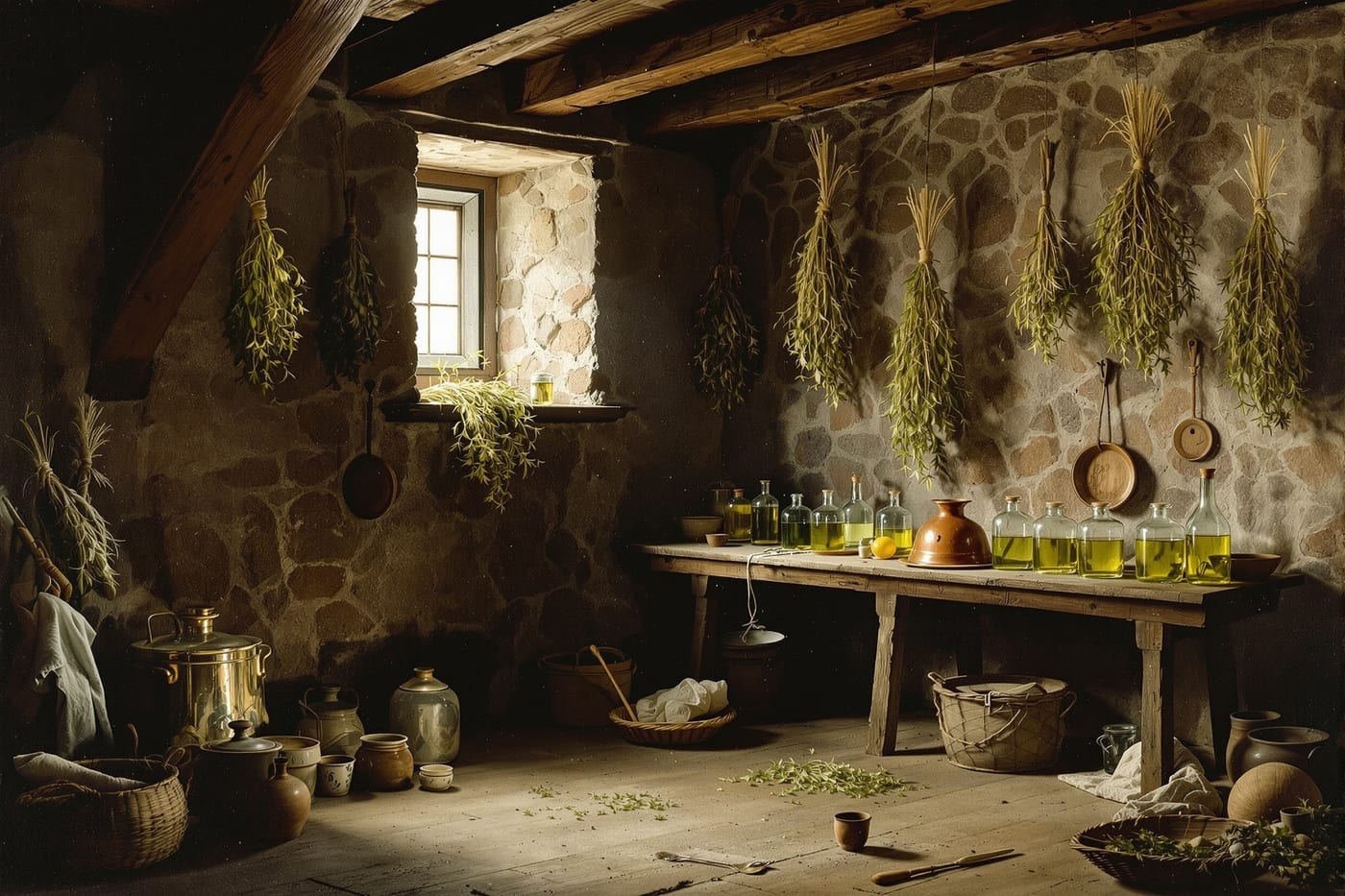
The story the trade tells begins in the Val-de-Travers, in the Swiss canton of Neuchâtel. Two sisters named Henriod, in the village of Couvet, are said to have hit on the idea of delivering the herb's reputed virtues in a rather more agreeable form: they steeped Artemisia and a handful of other mountain plants in high-proof alcohol and sold the result locally as a tonic, the Bon Extrait d'Absinthe. A French physician living nearby, Dr Pierre Ordinaire, is credited in some tellings with the same invention, and the two accounts have never been fully reconciled. What is not in dispute is what happened next.
After some twenty years the recipe passed to Major Daniel-Henri Dubied, who saw a business where the sisters had seen a remedy. Dubied opened a distillery in Couvet with his son-in-law Henry-Louis Pernod, and in 1805 the operation crossed the border to Pontarlier in France, where Maison Pernod Fils became the definitive absinthe house of the nineteenth century. Out of one Alpine village, the Green Fairy spread her wings.
How a tonic became a habit
Two accidents of history did more for absinthe than any advertising could. The first was military: French troops campaigning in North Africa in the 1830s and 1840s were issued absinthe as a fever preventative and water purifier, and brought the taste home with them. The second was agricultural. From the 1860s the phylloxera aphid destroyed the French vineyards, and with them the country's wine and its cheap brandy. Absinthe, distilled from grain or beet spirit, was untouched — and suddenly it was the affordable drink.
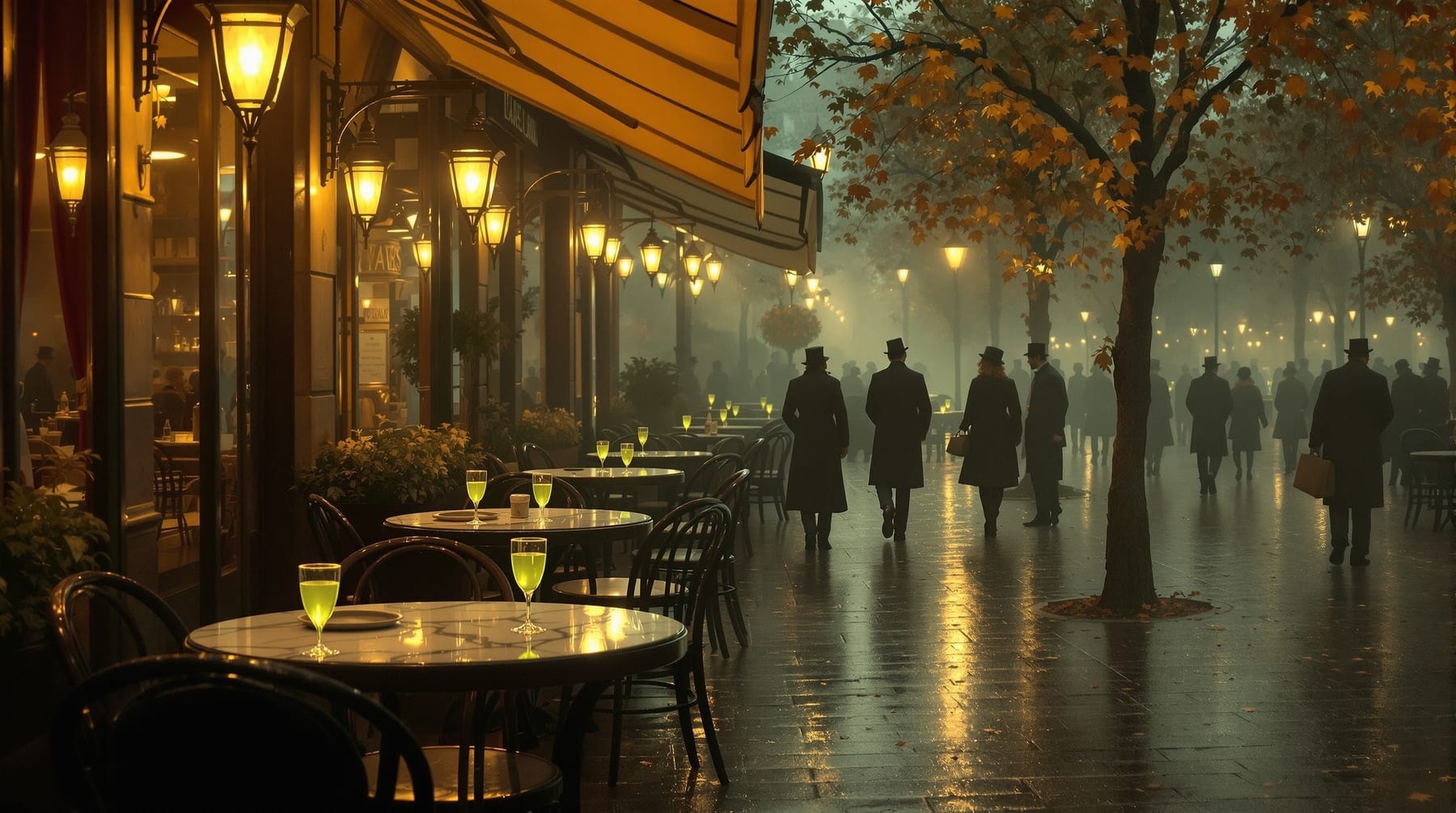
By the 1870s Paris kept an heure verte, a green hour, beginning around five in the afternoon, when the cafe terraces filled with the smell of anise and the slow clouding of water into glass. It was, for perhaps forty years, the most ordinary thing in France.
The muse argument
The reason absinthe is remembered while other lost drinks are not is that it was drunk by the people who were writing the century down. Rimbaud and Verlaine drank it while dismantling the metrical certainties French poetry had held for two hundred years. Baudelaire, Dowson, Wilde, Jarry, and later Hemingway all put it in print. Henri de Toulouse-Lautrec abandoned an aristocratic inheritance for the dance halls of Montmartre; the painter Gustave Moreau said of his work that it was “entirely painted in absinthe”.
The list of painters who put the glass itself in the frame is long enough to be a genre. Manet's The Absinthe Drinker in 1859 was rejected by the Salon and arguably began modern French painting's quarrel with respectability. Degas gave the subject its most famous canvas with Dans un café, better known as L'Absinthe, in 1876 — a picture so disliked in London when it was shown there that critics treated it as a moral warning rather than a painting. Van Gogh set a glass and a carafe on a cafe table in 1887 in a study the Van Gogh Museum still holds. Picasso returned to the subject repeatedly, in paint in 1901 and in painted bronze in 1914.
Whether the drink caused any of this is a separate question, and the honest answer is that it almost certainly did not. What it did was mark a room. Absinthe was what you drank if you were not a bourgeois, and the Belle Époque was an argument about who got to decide what a bourgeois was. The generation that gathered on the hill at Montmartre challenged the conventions of poetry, of painting, of who could vote and who could speak, and it did so over a green glass because that was the glass on the table.
“The absinthe hour, on the hill, never ends”
An Englishman named H. P. Hugh, writing in 1899, put it best: “The absinthe hour of the Boulevards begins vaguely at half-past-five and ends just as vaguely at half-past-seven. But on the hill, it never ends.” He was not the only foreigner drawn to the city. Americans, Italians, Dutch, Czechs and Russians all came, and the quarter absorbed them.
It did not last. Within twenty years of Hugh writing that sentence absinthe was illegal across most of Europe and North America, on evidence that would not survive an afternoon's scrutiny today. That story is told in the timeline, and the chemistry it rested on in the page on thujone.
What is left
What is left is the drink, legal again in most of the world since the mid-2000s, and better made now than at any point since 1915. And what is left is the argument the original essay made and this site still makes: that the interesting thing about absinthe was never the supposed chemistry of visions. It was that for one generation the drink stood for the refusal to be respectable, and that the refusal turned out to matter.
Absinthe Kits · absinthekits.com