Absinthe in art and literature
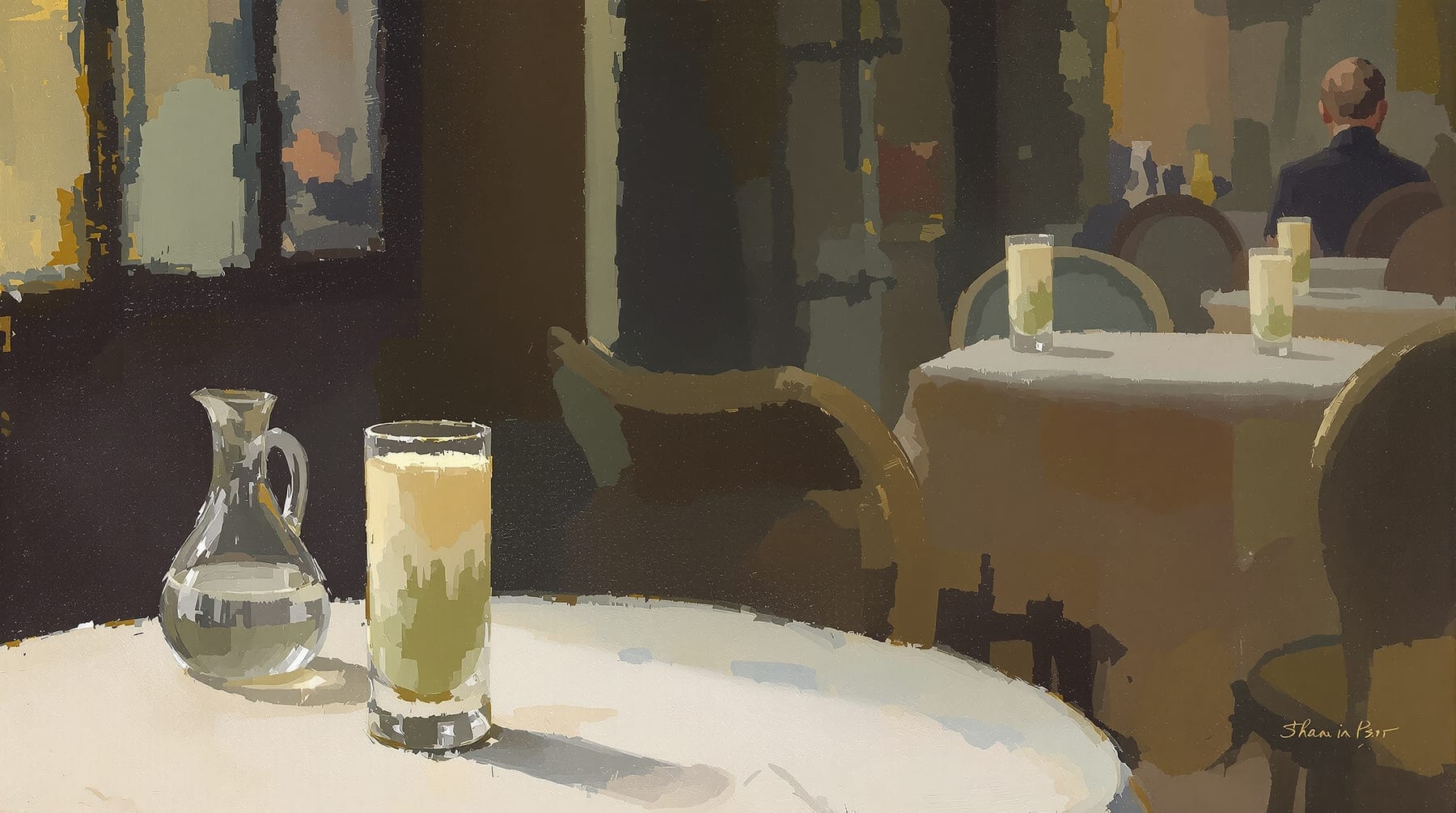
Plenty of drinks were popular in nineteenth-century France. Only one of them ended up in the permanent collections of half the museums in Europe. The reason absinthe is remembered is not chemical; it is that it happened to be on the table in front of the people who were inventing modern art.
Manet, 1859: the rejection
Édouard Manet's The Absinthe Drinker was his first major submission to the Paris Salon and it was refused. The subject was a rag-picker Manet knew, painted life-size and with complete seriousness — a full-scale portrait of a drunk, in a genre reserved for people who mattered. That was the offence. It is a reasonable place to date the beginning of the quarrel between French painting and French respectability, and the glass in the picture is what made the argument legible.
Degas, 1876: the picture that scandalised London
Edgar Degas's Dans un café shows a woman and a man at a cafe table, not looking at each other, a glass of absinthe in front of her. It is now generally reckoned among the great pictures of the century. When it was exhibited in London in 1893 under the title L'Absinthe, the British critics reacted as if to a public health notice, treating it as a lesson about degradation rather than a painting about isolation. The two sitters were, in fact, a well-known actress and a painter, posing.
Van Gogh, 1887
Vincent van Gogh's Café Table with Absinthe, painted during his Paris period, is a quiet still life: a glass, a carafe, a window. No drinker at all. It is held by the Van Gogh Museum. Van Gogh's illness has been attributed to absinthe more or less continuously since his death, usually via thujone; the attribution has no serious evidentiary basis and has been repeatedly reviewed and discarded.
Toulouse-Lautrec and Montmartre
Henri de Toulouse-Lautrec renounced an aristocratic inheritance to paint the dance halls and cabarets of Montmartre, to his family's considerable distress. His fellow painter Gustave Moreau's remark that his pictures were “entirely painted in absinthe” was not a compliment and has been quoted ever since as though it were a technical observation. Lautrec is also credited with a mixture of absinthe and cognac known as the Earthquake, which tells you something about the period's ideas of moderation.
Picasso
Picasso painted The Absinthe Drinker in 1901, during the Blue Period, and returned to the subject in 1914 with Glass of Absinthe — six painted bronze casts of a glass, each finished differently, each with a real perforated absinthe spoon and a bronze sugar cube on top. It is one of the founding objects of modern sculpture, and it is a bar accessory.
The writers
Arthur Rimbaud and Paul Verlaine drank it through the years in which they were taking French verse apart; Verlaine's late poems return to it with something close to remorse. Charles Baudelaire, Alfred Jarry, Ernest Dowson and Oscar Wilde all put it into English and French letters — Wilde's remark that after the first glass you see things as you wish they were, after the second as they are not, and after the third as they really are, being the single most quoted sentence on the subject and, characteristically, not really about drink at all.
The tradition carried into the twentieth century. Ernest Hemingway named a cocktail of absinthe and champagne Death in the Afternoon and published the recipe with instructions that are a joke about excess. A great deal of the source literature is available free at Project Gutenberg.
What it actually meant
The temptation is to read all of this as evidence that absinthe did something to these people. The simpler reading is that absinthe was what you drank in the cafes where this generation worked, and that painting or writing what was on the table was itself the modern move — the refusal to treat ordinary life as beneath art. The glass is in the canon because the canon changed its mind about what was worth looking at.
The broader argument is set out in The Spirit of Révolution; the chemistry that was blamed for all of it in the page on thujone.
Absinthe Kits · absinthekits.com