The ritual
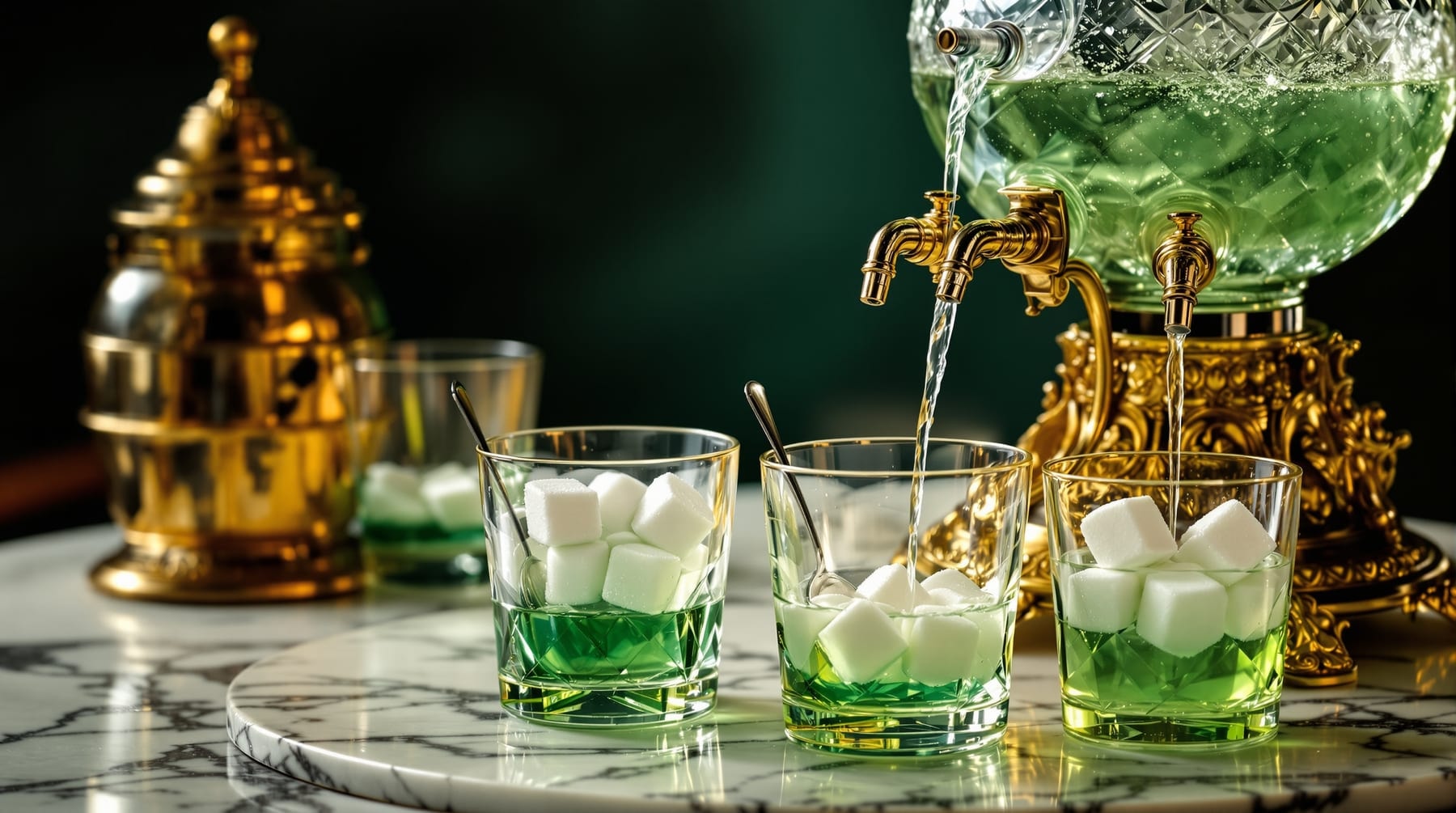
No other drink has a ceremony this elaborate attached to it, and the elaboration is not decoration. Absinthe is bottled at a strength nobody would drink neat, and it is built around a compound that behaves visibly when diluted. The ritual exists because the drink genuinely has to be prepared, and because the preparation happens to be worth watching.
The French method
The traditional sequence is short:
- A measure of absinthe goes into the glass — historically judged by eye against a moulded bulge or reservoir in the base.
- A slotted spoon is laid across the rim, and a sugar cube placed on it if sugar is wanted at all.
- Iced water is added slowly, drop by drop, through the sugar and the slots.
- The stream is kept thin and steady until the finished dilution is reached — conventionally somewhere between three and five parts water to one of absinthe, according to the strength of the spirit and the taste of the drinker.
Slowly is the operative word. Dumping the water in produces a coarse, flat mixture; a thin stream over a minute or more builds the emulsion gradually and, most tasters hold, gives a rounder result.
The louche
What happens in the glass is the louche, and it is the single most reliable indicator of how an absinthe was made. Anethole, the aromatic compound carried out of the anise, is freely soluble in strong alcohol and effectively insoluble in water. As the water goes in, the alcohol concentration falls past the point where the anethole can stay dissolved, and it comes out of solution as microscopic droplets suspended through the liquid. Those droplets scatter light, and the clear green turns milky and opalescent, with the cloud rolling down through the glass as the water descends.
A drink that does not louche at all has little or no anise in it. A drink that louches instantly and stark white usually has a great deal of star anise and not much else. A slow louche that builds in swirls and settles to a pearly, faintly luminous pale jade is the one the connoisseurs argue about.
The fountain and the glass
The absinthe fountain, or brouilleuse, is a footed glass reservoir with two, four or six small taps around its base, filled with iced water and set in the middle of a cafe table. Each drinker positions a glass under a tap and opens it to a slow drip. It is a convenience device that became a status object, and the surviving nineteenth-century examples are frequently magnificent.
The Pontarlier glass is the classic vessel: a stemmed glass with a heavy, narrow reservoir at the base that holds precisely one measure, so the drinker fills to the shoulder and then adds water to taste. Other regional forms used an etched line or a facet cut for the same purpose. Almost all of them are unusually stable and unusually heavy, for the obvious reason that something is going to be balanced on the rim.
What is not traditional
The routine in which absinthe is poured over a sugar cube, the sugar set alight, and the flaming mass dropped into the glass has nothing to do with the nineteenth century. It appeared in the 1990s alongside Czech-style “absinth” — usually not distilled, usually not anised, and therefore unable to louche — and it exists precisely because those products had no louche to show. Burning a good absinthe destroys the volatile aromatics it was made for and caramelises the sugar into the glass. It is also, given the alcohol strength involved, straightforwardly dangerous.
The other common modern error is over-icing. Absinthe wants cold water, not ice in the glass; ice cubes chill the mixture past the point where the aromatics carry and dilute unpredictably as they melt.
Sugar, and whether to bother
Sugar was never obligatory. In the Belle Époque it was a matter of taste and, quietly, of quality — a well-made absinthe from a good house was balanced enough to take water alone, while the cheaper products at the end of the century very much needed the help. The same holds now. The honest test is to prepare a glass without sugar first and add it only if the drink asks for it.
For the objects themselves — spoons, cubes and what they were for — see the anatomy of a kit. For why the anise matters so much to the whole performance, see the botanicals.
Absinthe Kits · absinthekits.com